The glass looks fine until the light catches it. Then a web of fine lines appears across the window, door or partition, and wiping the surface makes little difference. That is the frustrating thing about scratched glass: the marks can be easy to overlook from one position and distracting from another.
Some surface scratches can be treated by professional glass polishing. Replacement is therefore not the only possibility, but the depth of the damage, the surface finish and the condition of the panel all matter. A successful repair needs to improve the view as well as the appearance of the scratch.
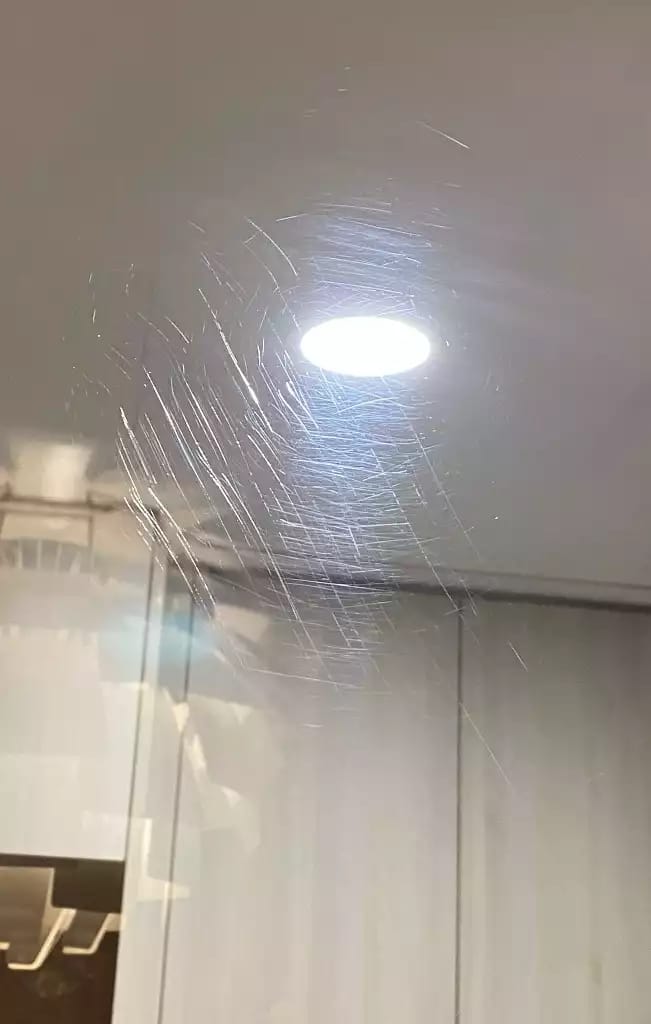
Fine lines become particularly visible around the ceiling-light reflection in this original photograph.
Why scratches suddenly stand out under the light
Look at the area around the round light in the photograph. Short, crossing lines become visible against the reflection, while other parts of the panel look quieter. A small close-up tells a different visual story from a view across the room.
This matters when deciding what result would be satisfactory. A partition might look acceptable in diffuse daylight but show distracting marks under the ceiling lights used every evening. Vitro's inspection guidance also notes that lighting conditions and backgrounds can change what is visible. The finish should be considered in the conditions where the glass is actually used. Vitro glass-cleaning and inspection guidance.
Cleaning and scratch removal solve different problems
Cleaning removes material sitting on the glass. Scratch removal addresses damage to its surface. A cleaner may remove fingerprints and residue around a scratch, but that does not mean it can remove the scratch itself.
This is also why repeatedly scrubbing a stubborn mark can make matters worse. Grit caught in a cloth or cleaning tool can mark the glass. Vitro recommends clean, grit-free equipment and sufficient cleaning solution, and excludes metal scrapers from routine cleaning. Once ordinary, compatible cleaning stops improving the appearance, adding more force is a poor way to find out what the mark is. Vitro's cleaning precautions.
If the main problem is a cloudy film rather than individual lines, our guide to cloudy glass explains the other possibilities.
How professional glass polishing works
Glass restoration can involve polishing alone or a sequence of abrasive treatment and polishing, depending on the system and the damage. In an abrasive process, the technician works on the area around the scratch and blends it into the surrounding surface. The work is more involved than rubbing along a single line.
CR Laurence's restoration manual describes this gradual blending as feathering. It also explains the trade-off: deeper damage can require more surrounding glass to be removed, increasing the risk of a visible change in the view through the panel. Sometimes leaving a faint trace is preferable to creating a distracting distorted patch. CR Laurence restoration manual, section on optical distortion.
Equipment manufacturers distinguish between different treatment stages too. GlasWeld separates its polishing approach for lighter damage from a multi-step process using micro-abrasive discs for heavier damage. Each process has its own requirements and limitations. GlasWeld's explanation of scratch-removal techniques.
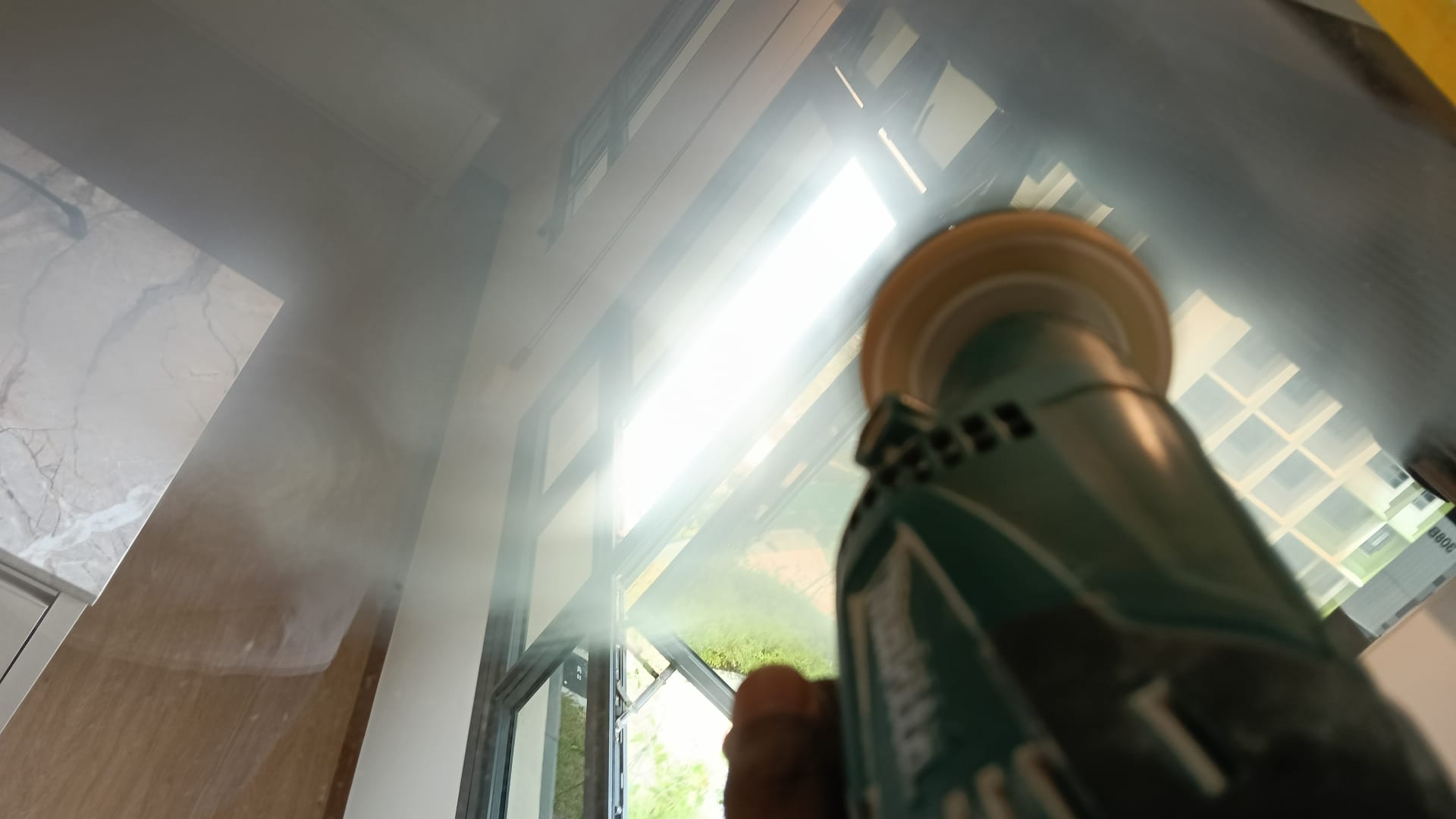
A round tool pad against an installed glass panel.
When scratch removal is worth considering
Surface treatment is worth exploring when the concern is visible scratching on otherwise serviceable glass. The useful outcome is a clearer panel with an acceptable finish, while retaining the installation.
There are limits. Pilkington's mechanical-removal guidance excludes surfaces with functional coatings, including its self-cleaning and anti-condensation coatings. It also warns that complete removal of deep scratches may not be possible and that the work can cause distortion or breakage. Coated glass therefore needs to be identified before anyone chooses a method. Pilkington's mechanical scratch-removal guidance.
A crack, damaged edge or loose panel changes the problem. Cosmetic improvement alone would leave those concerns unanswered. Our repair-versus-replacement guide separates surface work from problems involving the panel or its installation.
What should a good result look like?
Consider a scratched office partition with a door frame visible behind it. After treatment, the original scratch deserves a close look, but so does the view of that frame through the worked area. If the mark is less obvious yet the background now looks uneven, there is another visible issue to discuss.
A useful review therefore includes the whole panel, the treated area and the transition into the surrounding glass. Comparable before-and-after photographs help explain the change. Looking from the normal seating or standing position is just as relevant as inspecting a close-up under a bright light.
Common questions about scratched glass
Does a scratch that catches a fingernail always require replacement?
That is too simple a rule. GlasWeld specifically describes treating some scratches that can be felt with a fingernail. It does not follow that every deep scratch is suitable for treatment: the glass, location and likely optical result still have to be considered. GlasWeld scratch-depth FAQ.
Is a bottle of glass scratch remover the same as professional polishing?
A product label does not establish compatibility with your installed panel. Professional treatment also involves identifying the surface, choosing a process and checking the finish. That is particularly relevant where coatings or a large viewing area are involved.
Is polishing always cheaper than replacement?
There is no useful universal price comparison. The affected area, access, proposed work and replacement specification belong in the comparison. A small mark on a large fixed panel and widespread damage on a small pane present different decisions.
Glass scratch removal in Singapore
If scratches are spoiling a window, door or partition, send us a close-up and a full-panel photograph on WhatsApp. Include the approximate size and any known coating information so the discussion starts with the actual glass. You can also read about the glass scratch removal service.