The first question after noticing damaged glass is often, “Can this be repaired?” A better starting point is to identify what needs fixing. Is the problem the view through the panel, the way a door or window moves, or damage to the glass itself?
Those distinctions matter because “glass repair” can describe several kinds of work. Polishing a surface, replacing worn hardware and fitting a new pane have different purposes. Choosing the right one means paying for work that addresses the actual fault.
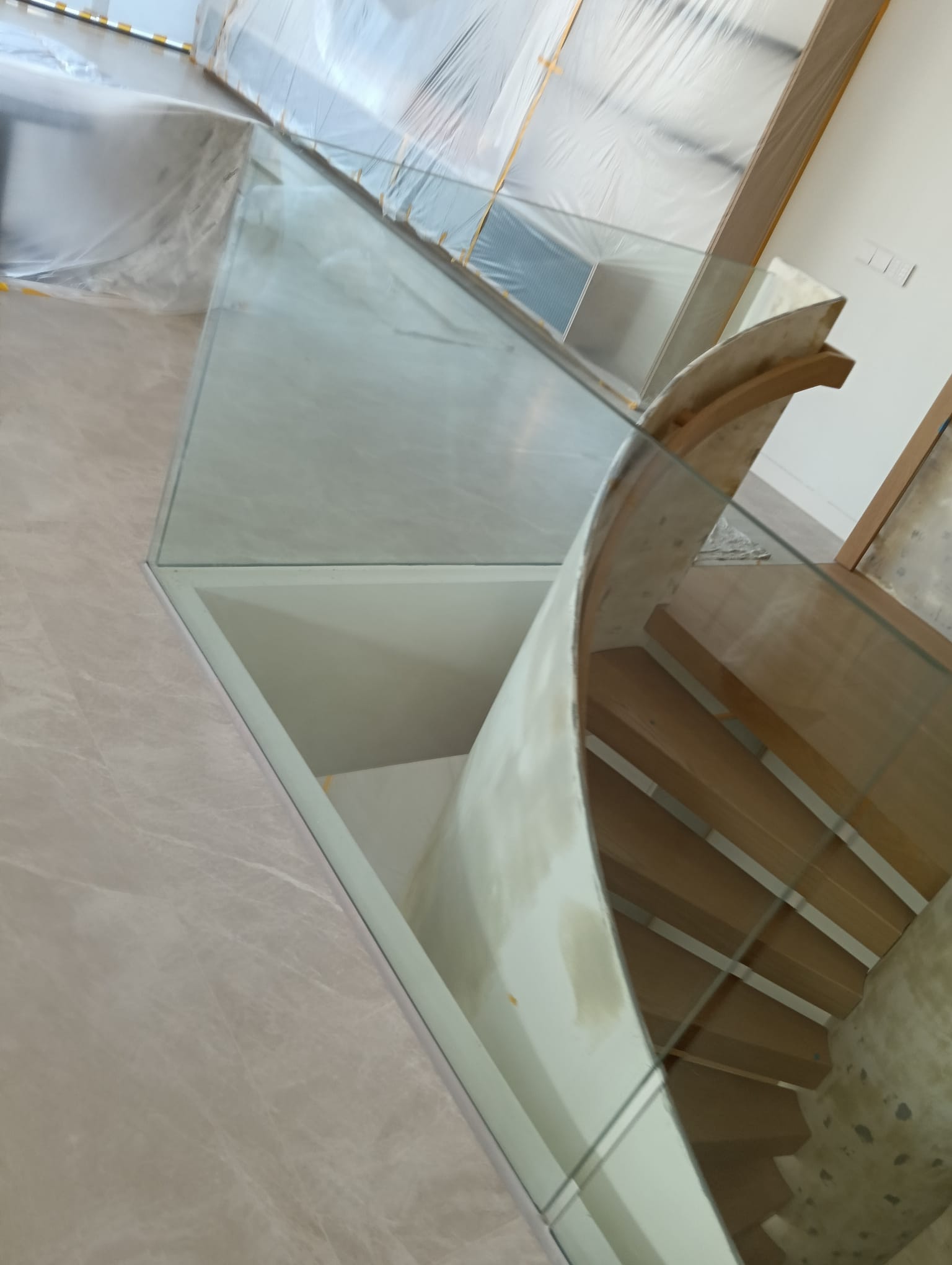
The glass around this staircase is part of a larger installation. Its position and supports matter alongside its appearance.
Three jobs that should not be confused
| Type of work | What it addresses | What it does not automatically resolve |
|---|---|---|
| Surface restoration | Suitable scratches or persistent surface marks | Cracks, loose supports or faulty operation |
| Hardware or installation repair | Identified faults in moving parts or supports | Scratches across the glass surface |
| Glass replacement | A pane or glazing unit that needs to be changed | A separate problem in a frame or fitting left in place |
Consider a sliding window that catches when opened. The glass might be clear and intact, while the operating components need attention. Now consider a fixed partition with visible scratches: there are no moving components to explain that problem. Finally, a cracked pane requires a decision about the damaged glass, even if the handle still works perfectly.
The same word—repair—can appear on all three enquiries. The work behind it should be described much more precisely.
When keeping the existing glass is worth exploring
Surface restoration can be worth considering when the complaint is cosmetic and the installation is otherwise suitable to retain. The objective is straightforward: improve the affected area without leaving an unsatisfactory view through the panel.
That option has limits. Pilkington's mechanical scratch-removal guidance warns about deep scratches, distortion and damage risk, and excludes surfaces carrying certain functional coatings. A treatment method must therefore suit the actual surface. Pilkington's scratch-removal guidance.
The glass scratch removal article explains that trade-off in more detail. For a homeowner, the key question is whether the expected finish would solve the reason the mark bothers you.
When the panel and its installation need closer attention
A damaged edge or a crack should not be treated as an ordinary surface blemish. Pilkington's breakage guidance identifies damaged edges and installation-related loading among the possible contributors to glass failure. Understanding why the damage occurred can matter as much as supplying another pane. Pilkington's guidance on investigating glass breakage.
This is especially relevant when the glass has a protective role, such as around a staircase. The question is broader than whether a small area can be made less visible: it concerns the panel, its support and its intended use.
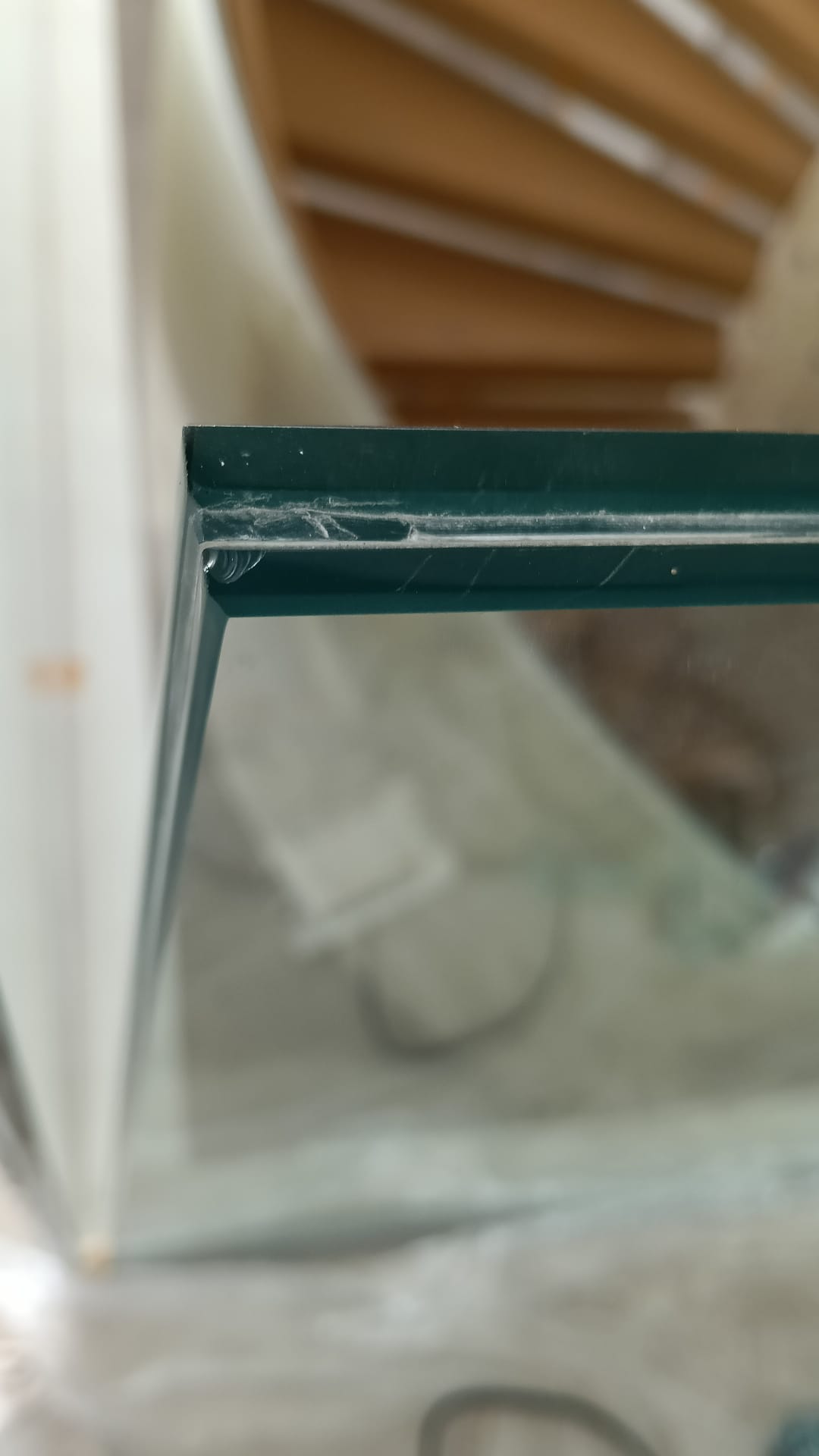
Close view of an irregular area at the corner of a glass panel.
The wide staircase photograph and this edge detail illustrate two scales of the problem. One shows where glass sits in the room. The other draws attention to a small area that could be lost in a wide photograph. Neither view, on its own, establishes what work was required or completed.
For an actually cracked or loose panel, keep people clear of the affected area and arrange professional attention rather than testing or handling it yourself.
Replacement should answer more than “what size is the glass?”
A replacement proposal needs to identify the panel or unit, the intended glass specification and the work required to fit it. Matching the opening dimensions alone does not explain how the glass will perform or how it will be supported.
For example, Pilkington's advice for glass barriers considers the barrier style, fixing method, loading and panel size when determining a specification. That is a useful illustration of why a staircase panel cannot be specified from a photograph alone. It is not a substitute for the applicable Singapore requirements. Pilkington glass-application FAQ.
If the proposed work leaves existing frames or fittings in place, their suitability still needs to be considered. Replacing the visible pane would be an incomplete answer if a separate installation fault remained.
A local point for HDB windows
HDB states that window works may only be performed by BCA-approved window contractors listed with HDB. Check that requirement when arranging work on an HDB window; a general glass-service description does not establish the contractor's approval status. HDB's window maintenance guidance.
This is different from choosing a cleaner for an internal partition. The type and location of the installation change what needs to be checked before work starts.
Is repair cheaper than replacement?
Compare complete proposals for your own installation. “Polishing” and “replacement” on two price lines are not enough if they include different work.
For a useful comparison, put the following items side by side:
- The exact panel and area included.
- The expected appearance or operating result.
- Any separate inspection or trial work.
- Access, protection of surrounding finishes and reinstatement.
- Frames, fittings, removal and disposal, where relevant.
- Any limitations that remain after the work.
Imagine a large fixed panel with one localised scratch. Keeping it may be an option worth investigating. For a different panel with extensive damage and a modest replacement scope, the balance may change. These examples explain the decision; they are not price or savings estimates.
Choose the work that solves the whole problem
A clear outcome is more useful than the label “repair.” For surface work, that outcome concerns the finish and view through the glass. For moving windows or doors, it concerns the identified operating fault. For replacement, it concerns the correct pane or unit fitted into a suitable installation.
If you are weighing the options, send us the installation and damage photographs with a short description of what is wrong. The glass replacement service page explains the replacement enquiry route.