Cloudy glass is frustrating because “clean it again” seems like such an obvious answer. Yet a panel can remain dull after fingerprints and ordinary dirt have gone. It may show a broad milky patch, fine streaks in the light or a mist that appears impossible to reach.
The word haze describes the appearance. It does not identify the cause. A film on an accessible surface, an optical effect in coated glass and moisture inside a sealed glazing unit need different responses.
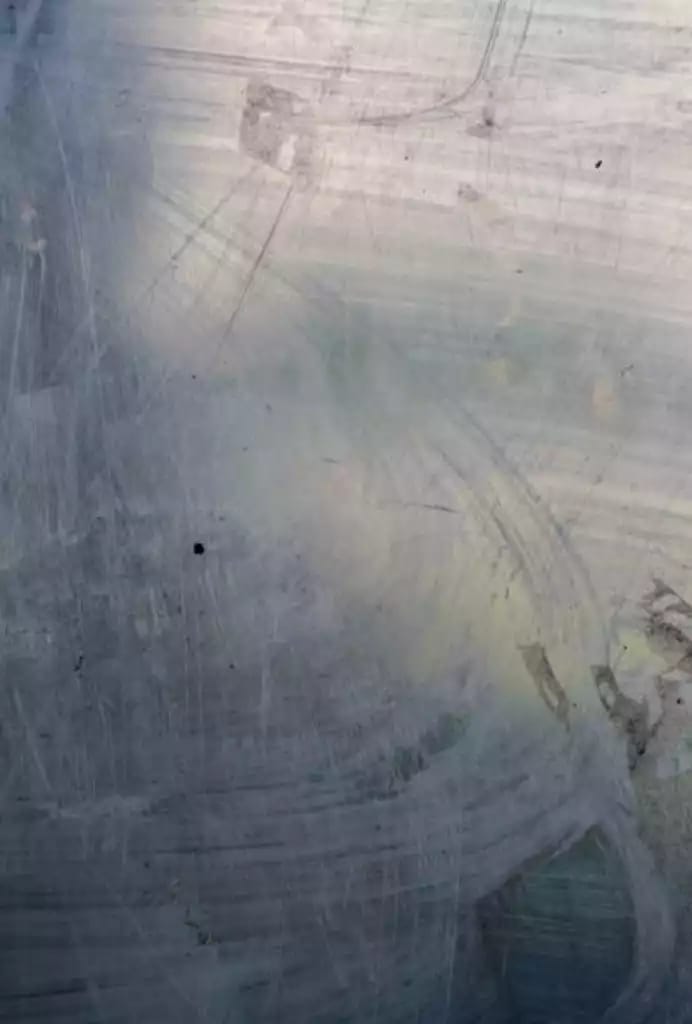
Curved streaks and uneven cloudiness across a glass surface.
Start with the pattern of the cloudiness
The first photograph has a strongly patterned appearance: overlapping curves, vertical lines and areas of different clarity. That is useful visual information. Calling the whole panel “foggy” would hide those details.
Compare that with an evenly misted window or a panel whose appearance changes dramatically when you move sideways. Similar everyday descriptions can refer to very different conditions. The table below is a way to separate them, not a diagnosis from appearance alone.
| What you notice | One possibility to investigate | Why the distinction matters |
|---|---|---|
| Smears or a film on a reachable surface | Residue left on the glass | Compatible cleaning may address the material on the surface. |
| Fine lines that remain after cleaning | Surface scratching or abrasion | Further cleaning does not perform the same work as scratch treatment. |
| Haze strongest under angled light | A surface or coating-related optical effect | The glass specification matters before choosing treatment. |
| Moisture on the room-facing or outside surface | Surface condensation | Temperature and moisture conditions matter. |
| Misting within the cavity of double glazing | A sealed-unit problem | Polishing the outside cannot reach moisture between the panes. |
Residue and surface wear can look similar
A streaked panel may have residue on it, surface damage, or both. The practical difference becomes clearer after suitable cleaning: what has lifted away, and what is still present in the dry glass?
Pilkington's cleaning guidance explains why care is needed during that first stage. Abrasive particles can become trapped in cleaning materials and mark the surface. Using the same dirty pad more vigorously can turn a cleaning problem into a scratch problem. Pilkington glass-cleaning guidelines.
If individual scratch lines remain, glass polishing and scratch removal become the relevant subject. If the problem is specifically a shower enclosure, the shower-glass guide covers deposits, care and surface deterioration in that setting.
Some coated glass has its own optical appearance
Not every haze is something stuck to the glass. Pilkington describes a limited haze effect in its K Glass product under particular lighting conditions: the coating scatters some light, making a fine, dusty-looking appearance more visible from certain angles. Pilkington window FAQ on haze.
This is a product-specific example, but it illustrates an important decision. Removing material from the surface is not an appropriate default response to an optical characteristic. First establish whether the panel has a coating or a specified decorative finish. Otherwise, someone could try to remove a feature that belongs to the glass itself.
Condensation on the surface is different from misting between panes
Condensation can form when moist air meets a glass surface cold enough for water to condense. Pilkington discusses how cold air from air-conditioning outlets can contribute to exterior condensation by cooling the glazing. A misted outside surface therefore does not, by itself, establish that a window unit has failed. Pilkington technical bulletin on surface condensation.
For double glazing, moisture between the panes is a different matter. Pilkington identifies inter-pane misting as a sign of seal failure and advises replacement of the glass unit. Surface polishing cannot repair that sealed cavity. Pilkington window FAQ on condensation.
The same distinction applies to an enquiry about “fog”: say whether it wipes from an accessible side, appears only at certain times, or seems to remain inside the assembly. Do not dismantle a window to investigate it.
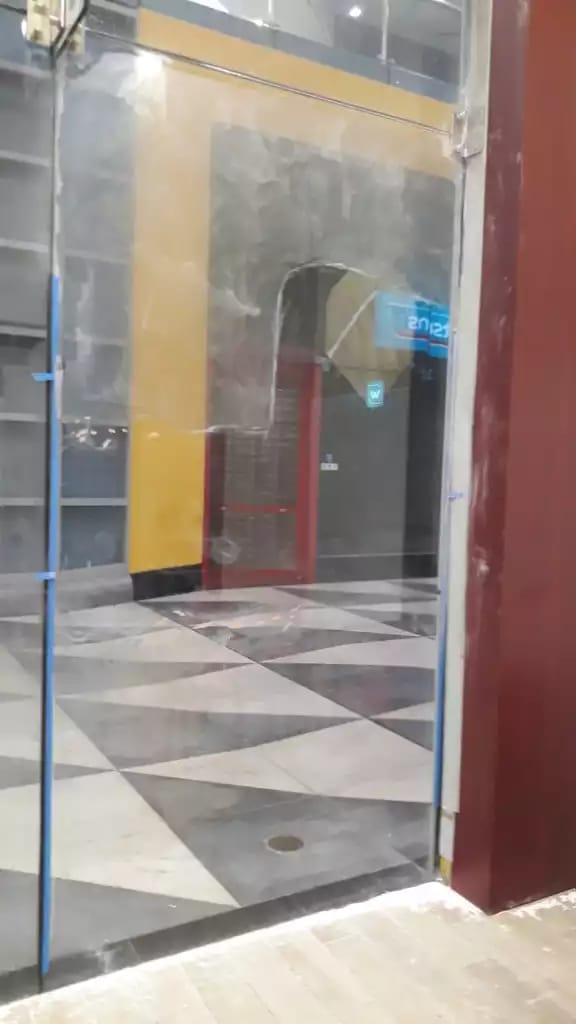
This second photograph shows noticeably different clarity across one view of a panel. The edge of the clearer area is visible against the scene beyond.
Why the whole panel matters
In the second photograph, the central area lets you see the room beyond more clearly than some surrounding areas. That makes it a useful illustration of uneven appearance. It does not tell us how the clearer area was produced.
When considering treatment, this kind of contrast raises a practical question: will the finished panel look consistent across its full viewing area? A clear patch surrounded by haze may still be distracting. The edges of the worked area and the view through the whole installation belong in the review, not just the centre of a close-up.
For example, a shopfront viewed from the pavement and a partition viewed from a desk have different everyday sightlines. The finish should make sense from those positions, as well as under inspection lighting.
Choosing the next step for cloudy glass
The right direction follows the condition: compatible cleaning for removable residue, a restoration discussion for suitable surface damage, product guidance for a coating effect, or glazing-unit work for confirmed inter-pane misting. Treating every cloudy panel with the same polishing process skips the most important part of the problem.
If you have cloudy glass in Singapore, send us a full view and a close-up. Explain which side the marks appear to be on and whether they change after cleaning or at different times of day. That helps the discussion start with the likely type of problem.